Football Gym Strength Training Transfer Score in Practice: A Winger Acceleration Example
- Complete Performance
- Jun 27
- 12 min read

In Part 1, I introduced the idea behind the Football Gym Strength Training Transfer Score.
The main message was simple: gym exercises should not be judged only by whether they are generally good or popular. Their value depends on the player, the problem, the exercise, and the timing.
In this second part, I want to make the system more practical.
To do that, I will use a common football example: a winger who has good top speed, but struggles with first-step acceleration and re-acceleration.
This is a situation many practitioners will recognize. The player may look fast once he opens up, but he loses important moments in the first few metres. He arrives slightly late to press. He struggles to create separation in 1v1 situations. After braking or changing direction, he needs too long to accelerate again.
In football, these small moments matter.
The difference between arriving half a second earlier or later can decide whether the player wins the ball, forces an error, creates separation, or loses the advantage.
Player Profile
Let us imagine a 22-year-old winger.
He is technically good, has good top speed, and covers high-intensity distance well during matches. On paper, he does not look like a slow player. In fact, over longer distances, he is one of the faster players in the squad.
But the coaching staff notice a recurring problem.
In short explosive actions, he is not as effective as expected.
He often loses the first two steps when pressing the opposition full-back. In attacking transitions, he sometimes needs too long to separate from the defender. In 1v1 situations, he has speed, but not always the first-step explosiveness to create immediate advantage.
The coach describes him simply:
“He is fast once he gets going, but he is not explosive enough in the first steps.”
This is an important distinction.
The problem is not maximum velocity. The problem is acceleration and re-acceleration.
Testing Profile
Testing helps confirm the coach’s observation.
Test | Result | Interpretation |
5 m sprint | 1.08 s | Needs improvement |
10 m sprint | 1.86 s | Below target for position |
30 m sprint | 4.05 s | Acceptable |
Flying 10 m | 1.02 s | Good max velocity |
CMJ | 42 cm | Moderate |
Single-leg horizontal bound right | 2.15 m | Below left side |
Single-leg horizontal bound left | 2.35 m | Better side |
Rear-foot elevated split squat 3RM right | 74 kg | Deficit |
Rear-foot elevated split squat 3RM left | 82 kg | Stronger side |
Heavy sled 10 m | 2.35 s | Needs improvement |
From this profile, we can start to understand the problem more clearly.
The player is not limited by top speed. Once he is upright and moving, he can run fast. The issue is his ability to produce and express force early in acceleration, especially in short actions that involve braking, turning, or re-accelerating.
The gym-related limiters may include:
horizontal force production
unilateral lower-body strength
right-leg force deficit
posterior-chain contribution
explosive concentric power
eccentric braking ability for re-acceleration
This does not mean the gym will solve everything.
Acceleration is technical. It depends on posture, projection, rhythm, stiffness, coordination, and the ability to apply force effectively into the ground. The pitch work still matters. Sprint coaching still matters. Football context still matters.
But the gym can support the physical qualities that allow the player to express these actions better.
Defining the Gym Objective
For this player, the gym objective should not be written as “improve strength.”
That is too general.
A better objective would be:
Improve horizontal force production, unilateral lower-body strength, and explosive power to support first-step acceleration and re-acceleration.
This gives the gym program a clearer direction.
It also changes how we judge exercise selection.
We are not simply looking for good lower-body exercises. We are looking for exercises that fit this player’s problem.
This is where the Football Gym Strength Training Transfer Score becomes useful.
Quick Recap of the Scoring System
Each exercise is scored across five pillars:
Force capacity
Velocity / power expression
Direction or vector match
Unilateral and asymmetry relevance
Individual limiter match
Each category is scored from 0 to 5.
The total score is then converted into a percentage:
Strength Transfer Score = Total Score / 25 × 100
The higher the score, the stronger the transfer profile for this specific player and performance problem.
Again, the score is not fixed to the exercise. It changes depending on the context.
Scoring Common Exercises for This Player
Back Squat
The back squat is one of the most commonly used strength exercises in football. It can be very useful for developing general lower-body force capacity.
For this winger, however, it may not be the most direct solution.
His main issue is not a complete lack of general strength. His problem is first-step acceleration, horizontal force expression, and a right-leg deficit. The back squat can still support the program, but it may not be the highest-transfer exercise in this specific case.

Category | Score |
Force capacity | 5/5 |
Velocity / power | 2/5 |
Vector match | 2/5 |
Unilateral relevance | 1/5 |
Individual limiter match | 3/5 |
Total | 13/25 |
Strength Transfer Score: 52/100
This does not mean the back squat is a bad exercise. It simply means that, for this player and this problem, it may be more of a support exercise than the main intervention.
For another player, especially a young player with low general strength, the back squat could score much higher.
Heavy Sled Push
The heavy sled push is more directly connected to the acceleration problem.
It emphasizes horizontal force production, forward body orientation, and force application in a direction that makes sense for early acceleration.
For this winger, the sled push fits the performance problem better than a general bilateral strength exercise.

Category | Score |
Force capacity | 4/5 |
Velocity / power | 3/5 |
Vector match | 5/5 |
Unilateral relevance | 3/5 |
Individual limiter match | 5/5 |
Total | 20/25 |
Strength Transfer Score: 80/100
This makes the heavy sled push a high-transfer exercise for this player.
It does not replace sprinting. But it can support one of the key physical qualities needed for early acceleration: horizontal force production.
Rear-Foot Elevated Split Squat / Bulgarian Split Squat
The rear-foot elevated split squat is highly relevant because this player has a right-leg strength deficit and needs better unilateral force production.
Football actions are rarely perfectly bilateral. Sprinting, cutting, pressing, shooting, and re-accelerating all involve single-leg force application. If one side is clearly weaker, it may influence how the player produces force or tolerates repeated high-intensity actions.

Category | Score |
Force capacity | 4/5 |
Velocity / power | 2/5 |
Vector match | 3/5 |
Unilateral relevance | 5/5 |
Individual limiter match | 5/5 |
Total | 19/25 |
Strength Transfer Score: 76/100
For this player, the RFESS becomes a strong main exercise in the training block.
The goal is not just to increase the number in the gym. The goal is to improve single-leg force capacity and reduce the asymmetry that may be contributing to his acceleration and re-acceleration problem.
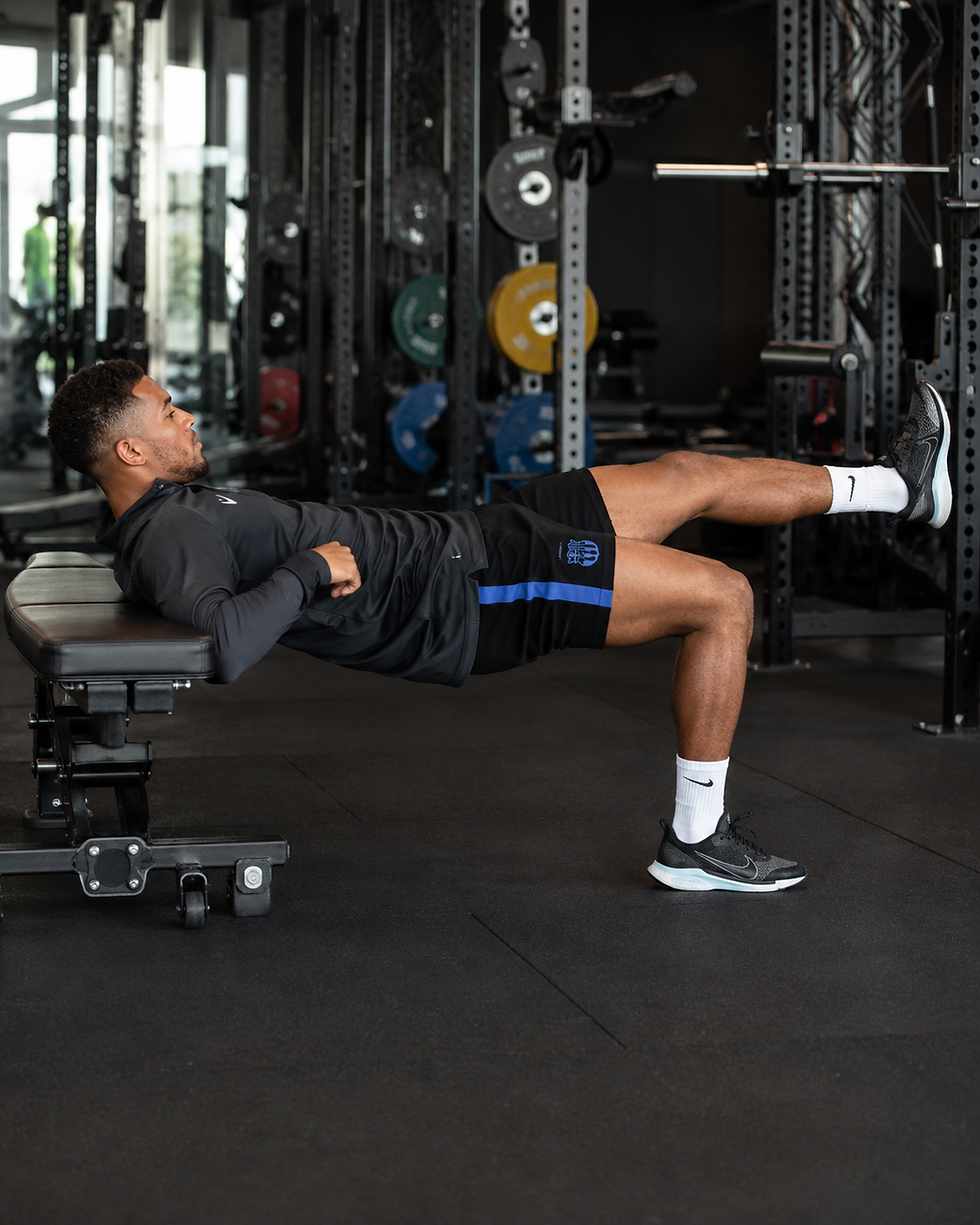
Single-Leg Hip Thrust
The single-leg hip thrust may also be useful for this player because it targets hip extension and posterior-chain contribution while keeping a unilateral emphasis.
For a winger who needs better horizontal force expression, hip extension strength can be an important support quality.
Category | Score |
Force capacity | 4/5 |
Velocity / power | 2/5 |
Vector match | 4/5 |
Unilateral relevance | 5/5 |
Individual limiter match | 5/5 |
Total | 20/25 |
Strength Transfer Score: 80/100
This exercise may be especially useful if the player shows weakness in posterior-chain force production or struggles to project effectively during early acceleration.
Trap Bar Jump
The trap bar jump develops explosive lower-body power. It allows the player to express force quickly with high intent.
For this player, it is useful, but it may not be as individually targeted as the sled push or unilateral exercises. It has strong value for power expression, but less direct unilateral or horizontal specificity.

Category | Score |
Force capacity | 3/5 |
Velocity / power | 5/5 |
Vector match | 3/5 |
Unilateral relevance | 1/5 |
Individual limiter match | 4/5 |
Total | 16/25 |
Strength Transfer Score: 64/100
This would be a good support exercise for explosive output. It may not be the main exercise in the block, but it still plays an important role.
Single-Leg Horizontal Bound
The single-leg horizontal bound is not a maximum strength exercise, but it is highly relevant for this player.
It expresses horizontal power, single-leg projection, and limb-to-limb differences. It can also act as a bridge between gym strength and pitch-based acceleration work.
Category | Score |
Force capacity | 2/5 |
Velocity / power | 5/5 |
Vector match | 5/5 |
Unilateral relevance | 5/5 |
Individual limiter match | 5/5 |
Total | 22/25 |
Strength Transfer Score: 88/100
For this player, the single-leg horizontal bound has a very high transfer score.
However, it should not replace strength work. It should complement it. Heavy strength work may build the capacity, while bounding helps express and coordinate that capacity in a more dynamic task.
Building a High-Transfer Gym Session
Once the main exercises are scored, the practitioner can build a gym session around the player’s performance problem.
For this winger, the session could look like this:
Exercise | Sets × Reps | Main Purpose | Transfer Score |
Heavy sled push | 5 × 10 m | Horizontal force | 80 |
Rear-foot elevated split squat | 4 × 5 each leg | Unilateral force | 76 |
Single-leg hip thrust | 3 × 6 each leg | Hip extension / posterior chain | 80 |
Trap bar jump | 4 × 3 | Explosive power | 64 |
Single-leg horizontal bound | 4 × 3 each leg | Horizontal power expression | 88 |
Nordic hamstring | 3 × 4 | Hamstring eccentric strength | 70 |
The average session score would be approximately 75–80/100, depending on how each exercise is weighted.
This would be considered a high-transfer gym session for a winger whose main problem is acceleration and re-acceleration.
But this is where context remains important.
The same session may not be ideal for a centre-back who needs more aerial power. It may not be the priority for a midfielder who struggles with repeated decelerations. It may not be appropriate for a player in an early return-to-play phase.
A high-transfer session is only high transfer when it matches the player’s needs.
Weighting the Session
In practice, not every exercise should count equally.
A main exercise should have more influence on the session score than a small accessory exercise. For example, the heavy sled push and rear-foot elevated split squat may be the main interventions, while the Nordic hamstring may be included as important support work.
A weighted session may look like this:
Exercise | Transfer Score | Weight | Weighted Score |
Heavy sled push | 80 | 25% | 20.0 |
Rear-foot elevated split squat | 76 | 25% | 19.0 |
Single-leg hip thrust | 80 | 20% | 16.0 |
Trap bar jump | 64 | 15% | 9.6 |
Single-leg horizontal bound | 88 | 10% | 8.8 |
Nordic hamstring | 70 | 5% | 3.5 |
Session score | 76.9 |
Session Strength Transfer Score: 77/100
This tells us that the session is well aligned with the player’s current performance problem.
It also gives the practitioner a simple way to compare sessions across the week.
Interpreting the Score
The Strength Transfer Score can be interpreted using a simple zone system:
Score | Meaning | Practical Use |
0–40 | Low transfer | General development, rehab, or low-priority support |
41–60 | Moderate transfer | Useful support exercise |
61–75 | Good transfer | Keep in the program |
76–90 | High transfer | Main exercise for this player |
91–100 | Very high transfer | Usually highly specific or gym-to-field bridge work |
The aim is not to make every exercise high transfer.
A good program still needs support work. Players need tissue capacity, trunk control, mobility, recovery, injury reduction work, and general strength development. Some of these exercises may have lower transfer scores but still be valuable.
The score simply helps clarify the role of each exercise.
If an exercise has a low score, it may still belong in the program. But it should probably not be presented as the main solution to the player’s performance problem.
Weekly Structure Example
For this winger, the gym week may be organized around the match schedule.
Assuming match day is Saturday, the week could look like this:
Day | Focus | Example |
MD+1 | Recovery / tissue capacity | Isometrics, mobility, trunk, low-load work |
MD-4 | Main strength-power session | Horizontal force and unilateral strength |
MD-3 | Power / speed-strength | Jumps, bounds, low-volume explosive work |
MD-1 | Primer | Low-volume neural activation |
The main high-transfer session would likely sit around MD-4, when the player has enough time to recover before the match.
A possible weekly transfer profile may look like this:
Session | Main Aim | Average Transfer Score |
MD+1 recovery / tissue capacity | Recovery and robustness | 45 |
MD-4 strength-power | Acceleration qualities | 77 |
MD-3 power | Explosive expression | 72 |
MD-1 primer | Neural readiness | 65 |
This helps the practitioner understand the purpose of the week.
Not every day needs to be high transfer. Recovery and support work are also important. But the main performance session should clearly target the player’s priority.
Linking Gym KPIs to Football KPIs
The Transfer Score becomes more useful when combined with testing and football outcomes.
For this winger, useful links may include:
Gym KPI | Football KPI |
Heavy sled 10 m time | 5–10 m acceleration |
Rear-foot elevated split squat strength | Single-leg force capacity |
Single-leg horizontal bound | First-step projection |
Trap bar jump power | Explosive lower-body output |
Nordic hamstring strength | Sprint tolerance and posterior-chain capacity |
Eccentric split squat control | Deceleration and re-acceleration quality |
The goal is not to claim that one gym exercise directly causes match improvement. Football performance is complex, and many factors influence whether a player accelerates better during a game.
But if the gym program is targeted, measurable, and connected to the player’s problem, the practitioner has a much stronger rationale.
Over a four-to-six-week block, we may expect to see changes such as:
KPI | Baseline | Target |
5 m sprint | 1.08 s | 1.03–1.05 s |
10 m sprint | 1.86 s | 1.78–1.82 s |
CMJ | 42 cm | 44–46 cm |
Right single-leg horizontal bound | 2.15 m | 2.25–2.30 m |
Single-leg asymmetry | 9–10% | <5% |
RFESS right 3RM | 74 kg | 80–84 kg |
Heavy sled 10 m | 2.35 s | 2.25–2.30 s |
These targets are only examples, but they show how the gym program can be linked to measurable outcomes.
How Practitioners Can Use This System
1. Exercise Selection
The first use is exercise selection.
Before adding an exercise, the practitioner can think about its role. Is it developing force capacity? Power? Horizontal force? Unilateral strength? Braking ability? Posterior-chain capacity? Trunk control?
This makes programming more intentional.
Instead of adding exercises because they are commonly used, the coach can choose exercises because they support the player’s specific performance problem.
2. Individualized Programming
The system also supports individualization.
Two wingers may need different programs.
One winger may need horizontal force and unilateral strength. Another may need hamstring capacity and sprint tolerance. Another may need trunk strength and contact robustness. Another may need low-load tissue capacity because he is returning from injury.
The Transfer Score helps practitioners avoid giving every player the same gym solution.
3. Communication With Coaches
Strength coaches and sport scientists often need to explain gym decisions to technical staff.
The Transfer Score can make this conversation easier.
Instead of simply saying:
“We are doing rear-foot elevated split squats today.”
The practitioner can explain:
“We are using this exercise because the player has a right-leg strength deficit that may be limiting his first-step acceleration and re-acceleration.”
That type of explanation connects gym work to football language.
It also helps technical coaches understand why certain exercises are prioritized.
4. Monitoring the Weekly Program
The Transfer Score can also be used to review the weekly program.
A player may complete several gym sessions across the week, but not all sessions have the same purpose. Some are designed for recovery, some for strength, some for power, some for robustness, and some for match-day readiness.
By tracking the average transfer score, the practitioner can see whether the gym program is aligned with the main performance goal.
This does not mean higher is always better.
It simply gives more clarity.
5. Supporting Return-to-Play Decisions
The system may also be useful in return-to-play.
Early rehabilitation exercises may have lower football transfer but high tissue relevance. As the player progresses, exercises should gradually become more specific to the football action that needs to be restored.
For example, a player returning from hamstring injury may move from isometrics and controlled strength work toward hip-dominant strength, eccentric hamstring loading, horizontal power, sprint exposure, and eventually football-specific high-speed actions.
The Transfer Score can help visualize this progression.
Important Limitations
The Football Gym Strength Training Transfer Score should not be used as a magic number.
It is a decision-support framework, not a perfect measurement of transfer.
There are several limitations.
First, the scoring includes practitioner judgment. Coaches may score the same exercise differently depending on their experience, philosophy, and understanding of the player.
Second, transfer is not only physical. A player may improve strength or power but still need technical coaching, tactical understanding, perception, timing, and confidence to express that quality during football actions.
Third, the timing of the season matters. A high-transfer exercise may not be appropriate if the player is fatigued, overloaded, sore, or in a congested fixture period.
Fourth, transfer should be evaluated over time. One high-transfer session does not guarantee performance improvement. Adaptation requires repeated exposure, appropriate progression, recovery, and integration with pitch training.
Finally, the score should not replace coaching intuition. It should improve the quality of coaching conversations.
Practical Tool: Football Gym Strength Training Transfer Score
To make the system easier to use in daily practice, I also developed an Excel-based Football Gym Strength Training Transfer Score tool.
The idea was to make the concept more practical, visual, and coach-friendly.
The tool allows practitioners to:
select the player, position, problem, objective, and exercise
score each gym exercise across the five transfer pillars
calculate the Strength Transfer Score automatically
classify exercises as low, moderate, good, high, or very high transfer
track weekly gym programming
connect exercises to player-specific strength-power problems
monitor test results and training decisions
use an exercise library with football-relevant gym exercises
This makes it easier to move from theory to daily application.
Instead of designing the gym program only around traditional exercise categories, practitioners can build it around the player’s actual football problem.
Stay tuned, and I will share it soon!
Final Thoughts
The Football Gym Strength Training Transfer Score is not designed to make programming more complicated.
It is designed to make the reasoning behind programming clearer.
A good gym program is not just a collection of good exercises. It is a targeted intervention based on the player’s needs.
For one player, the priority may be force capacity.
For another, it may be horizontal power.
For another, unilateral control.
For another, braking ability.
For another, posterior-chain robustness.
This is why the same exercise can have different value for different players.
The key is not to ask whether an exercise is good in general.
The key is to understand whether it is useful for this player, at this moment, for this football problem.
Player × Problem × Exercise × Timing
When these four elements are aligned, gym training becomes more than physical preparation.
It becomes targeted performance development.
✏️ Author: Assist. Prof. Armin Paravlić, PhD Complete Performance Education


Comments